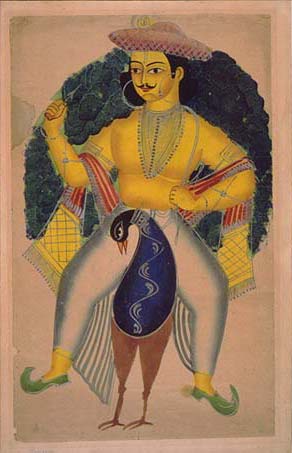
Karttikeya 19th Century Bengali watercolor
Opaque watercolor on paper
Bengal (Calcutta, Kalighat), 1870-85 Folk and Village Painting
Around 1830, local bazaar
artists operating souvenir stalls and booths around Calcutta's great Kali
temple began to produce bold, highly simplified folk paintings of Hindu
deities and scenes of everyday Bengali life. Pilgrims to the shrine bought
these pictures, known as "Kalighat" paintings.
This representation of Karttikeya -- Shiva's eternally young son, the god of war and the possessor of
transcendental knowledge -- is a typical Kalighat work. Karttikeya,
yellow-skinned and bare-chested, rides his peacock mount, represented in
frontal view. The precise outlines, rounded contours, and figural distortions
of the Kalighat idiom are a completely local style, but the shading and the
use of large sheets of paper reflect European influence.
Courtesy: Worlds of Wonder and Desire: Online Exhibition
|